Published Exclusively for: BudgetTipsHub.com
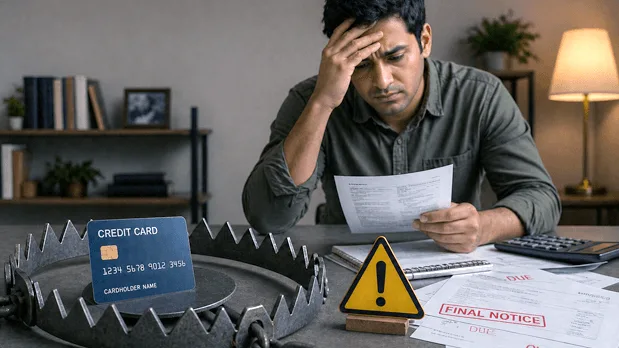
You pay your credit card bill on time every single month, yet your total balance barely drops by twenty dollars. Watching bank interest eat up 80% of your hard-earned payment feels unfair and exhausting. Thankfully, this step-by-step guide shows you how the minimum payment trap works. Better yet, you will learn six proven moves to slash your interest costs and pay off your card years faster.
How Banks Design the Minimum Payment Formula to Keep You Paying
Credit card companies do not set your minimum payment to help you get out of debt fast. Instead, they set the bar as low as possible so you stay a paying customer for decades. Most big banks figure out your minimum bill using one of two simple rules.
- The Flat Percentage Method. The bank charges you 2% to 3% of your total balance each month.
- The “1% Plus Interest” Method. The bank charges 1% of your main balance plus new monthly interest and any late fees.
Look at the latest Federal Reserve G.19 data. Credit cards that charge interest now carry an average rate of 22.36% APR. Suppose you owe $6,000 on a card at 22.36% APR. In a single month, that card adds $111.80 in pure interest to your bill.
If your bank uses the “1% plus interest” rule, your minimum payment is roughly $172. Out of that $172 check, $111.80 goes straight to bank profit. Only $60.20 actually lowers your $6,000 debt!
Why Your Minimum Payment Shrinks as You Pay
Here is the sneakiest part of the minimum payment trap. Your minimum bill is based on a percentage of your balance. Because of this, your required payment drops by a few dollars every month.
If you only pay the minimum number printed on your bill, you send less and less cash each month. As a result, a $6,000 balance can take over 23 years to pay off!
The Exact Math: What a $6,000 Balance Really Costs You
Numbers make the trap crystal clear. See what happens to a $6,000 credit card balance at 22.36% APR (Federal Reserve G.19 rate). The table below compares four different monthly payment habits.
| Payment Strategy | First Month Payment | Total Time to Pay Off | Total Interest Paid | Total Cash Saved vs. Minimum |
| 1. Shrinking Minimum Only (1% + interest, $35 floor) | $172 (drops each month) | 23 Years, 5 Months | $9,435 | $0 (You pay 2.5x the card balance!) |
| 2. “Freeze the Minimum” (Lock payment at $172 every month) | $172 (fixed every month) | 4 Years, 10 Months | $3,940 | Saves $5,495 and 18.5 years |
| 3. The “36-Month Box” Number (CFPB statement box) | $230 (fixed every month) | 3 Years (36 Months) | $2,288 | Saves $7,147 and 20.4 years |
| 4. Double the First Minimum (Pay $344 every month) | $344 (fixed every month) | 1 Year, 10 Months | $1,346 | Saves $8,089 and 21.5 years |
Look closely at Strategy #2 in the table above. You do not even have to pay more than $172 in Month 1 to save $5,495! Simply refusing to let your monthly payment drop below $172 cuts 18.5 years off your debt timeline.
6 Fast Ways to Break Out of the Minimum Payment Trap
You do not need a massive lottery win to escape high credit card interest. Combine these six practical moves to force your card balance down right now.
1. Use the “36-Month Warning Box” on Your Statement
Every monthly credit card bill contains a hidden cheat sheet required by federal law. The CFPB 3-year payoff guide explains how this works. Card issuers must print a warning box on your statement every month. That box shows two numbers.
- First, it shows how long it takes to clear your debt if you pay only the minimum.
- Second, it shows the exact monthly amount needed to wipe out the debt in 36 months (3 years).
Open your latest PDF statement tonight and find that 36-month number. Often, paying just $45 to $60 more per month locks in a guaranteed 3-year finish line. Just make sure you stop putting new charges on that card so the 3-year math stays on track.
2. Lock In Your Current Payment (“Freeze the Minimum”)
What if your budget is so tight that you cannot afford an extra $50 this month? You can still beat the bank’s math today. Write down your current minimum payment—say, $160. Then, set your online autopay to send a fixed $160 every single month.
Next month, your bank will drop your required minimum to $158. Ignore that lower number and keep sending $160. Every month, a bigger slice of your $160 check attacks the real debt instead of bank interest.
3. Switch to Biweekly Half-Payments
Most credit cards figure out your interest using your average daily balance across the month. Suppose you wait until the 30th of the month to send your payment. The bank charges you interest on the full balance for 29 straight days.
Instead, split your monthly payment in half and pay every two weeks. Say your fixed payment is $200 a month. Send $100 on the 1st and $100 on the 15th.
This simple habit does two great things for your wallet.
- It lowers your average daily balance. That trims your interest charge every single day.
- It sneaks in one full extra payment each year. Because a year has 52 weeks, making 26 half-payments equals 13 full monthly payments instead of 12.
4. Make a 5-Minute Phone Call to Cut Your APR
Many people assume credit card interest rates are set in stone. In reality, the FTC guide on getting out of debt says you can call your card issuer and ask for a lower rate. You do not need to pay a company to do this for you. You can make the call yourself for free.
Use this simple, polite script when you call.
“Hi! I have been a loyal customer, and I want to pay off my balance faster. Right now, my 24% APR makes that tough. I am looking at 0% balance transfer offers from other banks. Can you lower my APR or check if my account qualifies for a lower promotional rate?”
Suppose the agent lowers your rate by 4% to 6% for the next 12 months. Every single dollar you save on interest goes straight toward lowering your balance.
5. Move the Balance to a 0% Intro APR Card or Lower-Rate Loan
Is your credit score still in fair or good shape (670 or higher)? If so, you can stop the 22% interest clock right now. Compare the four main interest-cutting tools below to see which option fits your credit profile.
| Payoff Tool | Typical Interest Rate | Fees to Watch Out For | Best For Who? |
| 1. Direct Lender APR Call (FTC debt advice) | Drops rate by 3% to 6% (or temporary hardship rate) | $0 fee | Anyone who wants an instant rate cut without a credit check |
| 2. 0% Intro APR Balance Transfer Card (CFPB transfer guide) | 0% APR for 12 to 21 months | 3% to 5% transfer fee ($180–$300 on $6,000) | Borrowers with 680+ credit who can clear the debt before the promo ends |
| 3. Fixed Personal Consolidation Loan (Federal Reserve G.19) | 11.90% average APR (24-month bank loan) | 0% to 5% origination fee | People who want one fixed monthly payment and a strict payoff date |
| 4. Nonprofit Credit Counseling DMP (FTC debt advice) | Often lowers card APRs to 6% to 10% | Small monthly admin fee ($25–$50); cards are closed | Borrowers with low credit scores who are drowning in high minimum bills |
As the CFPB balance transfer guide notes, banks can charge a transfer fee on a 0% offer. Still, paying a one-time 3% fee ($180 on $6,000) to save $1,340 a year in interest is a huge win. Just follow the CFPB promo payoff rules and pay the full balance before the 0% window ends.
6. Send Weekly “Micro-Snowflakes” Straight to Principal
Do not wait until the end of the month to send extra money. Did you save $15 by cooking at home tonight? Or did you earn $40 selling an old jacket online? Log into your banking app that same night and send a $15 or $40 extra payment.
Smart savers on budgettipshub.com call these small mid-month payments “debt snowflakes.” Sending three $25 snowflakes a month adds $75 a month ($900 a year) straight to your debt. Because your regular minimum bill already covered the monthly interest, 100% of every snowflake cuts your core balance.
Real-Life Case Study: How Kevin Escaped a $6,000 Card in 18 Months
To see how these moves work together, meet Kevin, a 31-year-old warehouse supervisor. Kevin owed $6,000 on a rewards credit card charging 23.99% APR. For two years, he paid the $175 minimum every month. Yet his balance stayed stuck near $5,800 because he kept swiping the card for gas and food.
After grabbing a free bill-pay tracker from budgettipshub.com, Kevin took four simple actions over one weekend.
- He froze the card. Kevin deleted the card from his phone wallet and shopping apps. He switched all daily gas and grocery spending to his checking debit card.
- He called his bank. Following the FTC rate call advice, Kevin called his card issuer and asked for a rate cut. Because he always paid on time, the bank lowered his APR from 23.99% to 17.99% for 12 months.
- He locked in a biweekly payment. Instead of paying a shrinking $175 minimum, Kevin set up an automatic $125 payment every two weeks on payday.
- He added $50 a month in snowflakes. Kevin canceled two streaming apps and packed his work lunch twice a week. Then, he sent that extra $50 straight to his card each month.
Kevin paid $300 to $325 a month at the lower 17.99% rate. As a result, he wiped out the entire $6,000 balance in 18 months. He saved over $7,800 in interest and beat the bank’s minimum payment schedule by more than 20 years.
Take Control of Your Next Statement Tonight
Credit card banks count on you feeling too tired to look past the “Minimum Payment Due” box. Tonight, log into your card account and delete your saved card from your shopping apps. Next, set an automatic fixed payment for at least $25 to $50 above your current minimum. Even a small extra payment today breaks the bank’s interest trap and puts you back in charge of your money.
Official References & Data Sources
- Board of Governors of the Federal Reserve System: Consumer Credit — G.19 Release — Official federal data on commercial bank credit card interest rates (22.36% average APR on accounts assessed interest) and 24-month personal loan rates (11.90% APR).
- Consumer Financial Protection Bureau (CFPB): Understanding the 3-Year Payoff Box on Your Credit Card Bill — Official federal explanation of the CARD Act minimum payment warning box and 36-month payoff disclosures.
- Consumer Financial Protection Bureau (CFPB): What Is a Balance Transfer Fee and How Zero Percent Offers Work — Federal consumer guidance on balance transfer fees and promotional 0% APR credit card offers.
- Consumer Financial Protection Bureau (CFPB): Five Tips for Paying Off Promotional and Deferred Interest Balances — Official federal rules on paying more than the minimum and allocating extra payments on promotional balances.
- Federal Trade Commission (FTC): How To Get Out of Debt — FTC Consumer Advice — Official federal guidance on negotiating lower interest rates directly with credit card companies, working with nonprofit credit counselors, and avoiding debt-relief scams.
Disclaimer: The content provided in this article on BudgetTipsHub.com is for informational and educational purposes only and does not constitute professional financial, tax, or credit counseling advice. Always consult with a certified financial planner or accredited nonprofit credit counselor regarding your specific personal financial situation before making major financial decisions.