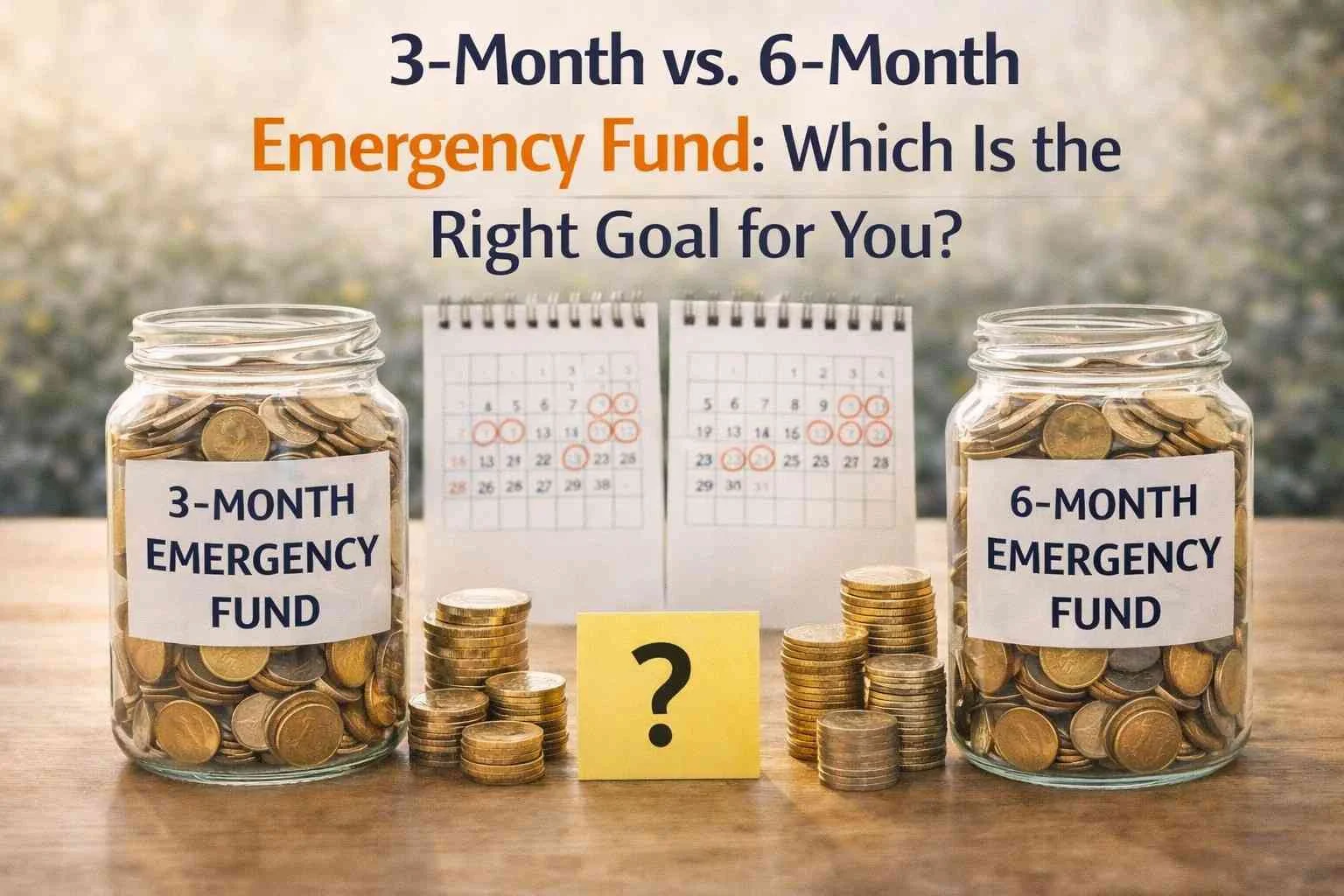
Watching your checking account drain after an unexpected layoff or a surprise $2,400 transmission repair is one of the most exhausting, stomach-dropping feelings in personal finance. Even if you followed the classic rule of thumb and saved three months of living expenses, this step-by-step guide will show you why today’s hiring timelines and sticky living costs demand a 6-month safety net—and exactly how to build yours without feeling broke every month.
Why the Classic 3-Month Rule Falls Short in Today’s Economy
For decades, standard financial advice treated a 90-day cash cushion as the finish line for household security. That benchmark assumed you could lose your job on a Friday, send out a few applications over the weekend, and start collecting a new paycheck within eight to ten weeks. Today’s labor market and household cost structure operate on a much slower, more expensive clock.
White-Collar Hiring Timelines Now Stretch Past Five Months
If your income disappears tomorrow, replacing it takes significantly longer than a single calendar quarter. According to the U.S. Bureau of Labor Statistics (BLS) Unemployed People by Duration of Unemployment Table A-12, the seasonally adjusted average duration of unemployment reached 24.8 weeks (nearly 5.7 months) in September 2026, after hitting 26.3 weeks in August 2026. That same BLS report reveals that 43.6% of unemployed workers have been searching for work for 15 weeks or more, while 27.1% have been out of work for at least 27 weeks.
Corporate hiring processes now routinely involve four to six interview rounds, take-home assessments, and weeks of administrative sign-offs before an offer letter arrives. Even after you sign an offer, background checks and biweekly payroll cycles often delay your first direct deposit by another three to four weeks. A 3-month emergency fund runs dry right in the middle of the average job search, forcing you to accept a lowball salary offer or swipe high-interest credit cards just to keep the lights on.
Sticky Fixed Costs Leave Zero Room for Error
When you lose a paycheck, you can cancel streaming services and stop dining out in five minutes, but your core survival bills will not budge. Data from the Federal Reserve Board’s Report on the Economic Well-Being of U.S. Households (SHED) shows that over 9 in 10 adults cite price increases as a financial concern, and 42% of adults worry about finding or keeping a job. Housing and insurance costs hit family budgets hardest: the Federal Reserve SHED report notes that 23% of renters fell behind on rent over the past year, while 34% of insured homeowners either struggled to afford their insurance premiums or could not afford as much coverage as they wanted.
When rent, mortgage payments, utilities, groceries, and insurance premiums consume 70% to 80% of your take-home pay, cutting discretionary “fun money” barely slows down your monthly cash burn. A larger reserve buys you the breathing room to keep paying those rigid bills on time without wrecking your credit score.
Financial Shocks Rarely Arrive One at a Time
Real-life emergencies have a nasty habit of clustering together in the same season. The Federal Reserve SHED report found that 59% of U.S. adults experienced at least one major unexpected expense over a 12-month period. Those surprise bills broke down across three primary budget-wreckers:
- Major vehicle repair or replacement: Experienced by 30% of adults (Federal Reserve SHED report), often costing $1,200 to $4,000 when a transmission, alternator, or brake system fails.
- Major home or appliance repair: Experienced by 22% of adults (Federal Reserve SHED report), such as a leaking water heater, HVAC failure, or storm-damaged roof.
- Unexpected major medical expenses: Experienced by 21% of adults (Federal Reserve SHED report), which become even more dangerous if a layoff simultaneously triggers expensive COBRA health insurance premiums.
Research from the Consumer Financial Protection Bureau (CFPB) on Saving for Financial Shocks and Emergencies highlights that roughly half of U.S. households are financially fragile—including about half of households earning $25,000 to $75,000 and a quarter of households earning over $75,000—meaning they cannot confidently raise $2,000 within 30 days. If a $2,500 medical deductible or car repair hits two weeks before a company restructuring, a 3-month fund evaporates in less than 60 days.
3-Month vs. 6-Month Emergency Fund: Who Needs Which?
Not every household faces the exact same income risk or monthly obligation load. Compare the risk factors below to see why most modern earners need a full six-month runway rather than a 90-day buffer.
| Household Factor | When a 3-Month Fund May Suffice | When a 6-Month Fund Is Essential | Financial Impact of Falling Short |
| Household Income Structure | Dual-income couples with two stable, roughly equal paychecks in different industries | Single-income earners, solo heads of household, or couples where one partner earns 70%+ of total income | Immediate cash shortfall if the primary earner is laid off or unable to work |
| Job & Industry Volatility | High-demand hourly or clinical roles with rapid hiring turnarounds (under 4 weeks) | Corporate, tech, finance, media, commission-based, freelance, or seasonal workers | Average job searches last 24.8 weeks (BLS Table A-12), outlasting a 90-day reserve |
| Dependents & Caregiving | Single renters with zero dependents, no pets, and easy lease flexibility | Parents with children, pet owners, or adults supporting aging relatives | Childcare and medical bills cannot be paused, accelerating monthly cash burn |
| Home & Vehicle Ownership | Renters using public transit where the landlord covers all appliance and roof repairs | Homeowners and daily commuters who rely on one or two out-of-warranty vehicles | Compound shock risk when a $2,000+ repair hits during an income gap |
| Health & Insurance Needs | Young adults with low medical usage and access to a spouse’s employer health plan | Individuals with chronic conditions, high-deductible plans, or reliance on COBRA | COBRA premiums alone can add $600–$1,800/month to your bare-bones survival budget |
Real-Life Case Study: How Marcus Survived a 5-Month Layoff Without Taking On Debt
To see how a 6-month buffer works in the real world, consider a realistic scenario involving Marcus, a 34-year-old project coordinator earning $5,200 per month after taxes. Marcus normally spends $4,400 a month covering rent, utilities, groceries, a car payment, insurance, dining out, and hobbies. After tracking his core survival expenses using a zero-based worksheet on budgettipshub.com, Marcus calculated that his strict bare-bones monthly survival number was $3,200.
Instead of stopping at a 3-month cushion ($9,600), Marcus spent 18 months building a 6-month emergency fund of $19,200 in a high-yield savings account. When his company eliminated his department in March, here is what happened to his cash flow over the next 22 weeks:
- Months 1 and 2 ($6,400 spent): Marcus immediately switched to his $3,200 bare-bones budget, pausing $1,200 a month in restaurant meals, subscriptions, and non-essential shopping. His state unemployment benefits took five weeks to process due to identity verification backlogs, so his emergency fund covered 100% of his rent, groceries, and utilities without stress.
- Month 3 ($4,350 spent): Just as his unemployment checks started partially offsetting his grocery bill, his sedan’s water pump and timing belt failed, costing $1,450, and he had to pay $650 out-of-pocket for an urgent dental crown. If Marcus had stopped at a $9,600 (3-month) fund, his cash balance would have dropped to zero in Week 11.
- Months 4 and 5 ($5,100 net spent after partial unemployment benefits): Because Marcus still had $8,450 left in his 6-month reserve, he did not panic. He turned down a desperate short-term role that would have cut his salary by 30%, completed four interview rounds for a senior coordinator position, and started his new job in Week 21 with $3,350 still sitting safely in his bank account.
The key takeaway: A 6-month fund does not just pay your bills; it protects your career negotiating power and keeps you out of 22% APR credit card debt when life throws two emergencies at you at once.
Step 1: Calculate Your True “Bare-Bones” 6-Month Target
Many savers quit before they even start because they multiply their total monthly paycheck by six, see a terrifying $30,000 target, and give up. Your emergency fund should never be based on your full lifestyle spending—it should be based strictly on your bare-bones survival expenses.
Pull up your last 90 days of bank and credit card statements and strip out every dollar you would immediately cut during a crisis. Use the breakdown below as a template to separate your non-negotiable survival bills from lifestyle spending.
| Expense Category | Normal Monthly Lifestyle Spend | Bare-Bones Emergency Spend | 6-Month Emergency Fund Allocation |
| Housing (Rent/Mortgage + Taxes) | $1,750 | $1,750 | $10,500 |
| Utilities (Electric, Water, Basic Internet, Phone) | $290 | $210 (downgrade speed/plans) | $1,260 |
| Groceries & Household Essentials | $650 | $480 (strict meal planning) | $2,880 |
| Transportation (Auto Loan, Insurance, Essential Fuel) | $520 | $390 (reduced commuting fuel) | $2,340 |
| Health Insurance Out-of-Pocket & Prescriptions | $220 | $220 | $1,320 |
| Minimum Debt Payments (Student Loans/Credit Cards) | $150 | $150 | $900 |
| Dining Out, Coffee, Bars & Delivery Apps | $420 | $0 (paused during crisis) | $0 |
| Streaming, Gym, Subscriptions & Shopping | $400 | $0 (paused during crisis) | $0 |
| Total Monthly & 6-Month Target | $4,400 / month | $3,200 / month | $19,200 Total Safety Net |
Notice how switching from total lifestyle spending ($4,400) to bare-bones survival spending ($3,200) lowers the 6-month savings target by $7,200 ($19,200 instead of $26,400). If you live in a household where unemployment benefits or a partner’s reliable income would cover $1,000 a month in a worst-case scenario, you can customize your target with precision.
Step 2: Build Your 6-Month Cushion Using the 4-Milestone Ladder
Staring at a $15,000 or $20,000 savings goal feels overwhelming when your account balance is sitting at $300. Break the journey into four smaller psychological milestones so every deposit delivers an immediate win.
Milestone 1: The $1,000 to $2,000 Starter Shock Absorber
According to the Federal Reserve SHED report, 37% of adults cannot cover a $400 emergency expense using cash or its equivalent. Your very first mission is to save $1,000 to $2,000 as fast as possible to match the CFPB’s $2,000 financial resilience threshold. This starter buffer stops flat tires, veterinary visits, and broken appliances from pushing you deeper into credit card debt while you stabilize your monthly cash flow.
Milestone 2: The 1-Month Bill Buffer
Once your starter fund is locked in and any high-interest credit card debt (above 10% APR) is paid off, push your reserve to one full month of bare-bones expenses. Having a full 30 days of bills sitting in reserve breaks the paycheck-to-paycheck cycle for good. You no longer have to worry whether your rent check will clear on the 1st if a client or employer pays you three days late.
Milestone 3: The 3-Month Halfway Mark
Next, build from one month to three months of bare-bones expenses using automated biweekly transfers. Reaching 90 days of coverage protects you against short medical leaves, minor job transitions, and seasonal slowdowns. Celebrate hitting this halfway point, because you now have more liquid protection than the majority of households.
Milestone 4: The Full 6-Month Fortress
For the final stretch from Month 3 to Month 6, combine your steady monthly transfers with “windfall sweeps.” Route 80% of every tax refund, annual work bonus, cash-back reward, and third-paycheck month directly into your emergency fund. Once you hit six months of bare-bones expenses, you can redirect all future monthly savings toward retirement investing, mortgage payoff, or wealth building.
Step 3: Find an Extra $400 to $600 a Month Without Feeling Deprived
You do not need a six-figure salary to fund a 6-month reserve; you need a system that captures leaked cash before you accidentally spend it. Following the CFPB’s guidance on building a savings habit, setting up a repeatable, automatic system is far more effective than relying on willpower at the end of the month.
- Split your direct deposit at the payroll level: Ask your employer’s payroll department (or adjust your HR portal settings) to send 10% to 15% of every paycheck directly into a separate savings account before the rest hits your main checking account. As the CFPB’s research on saving for emergencies confirms, making savings automatic through payroll deduction removes daily spending temptation.
- Run a 30-day fixed-bill audit: Call your auto and home insurance carriers to request a coverage re-quote, negotiate your home internet promotional rate, and switch from overpriced flagship wireless plans to a reliable prepaid carrier. Trimming $140 a month from fixed recurring bills adds $1,680 a year to your emergency fund without changing your daily lifestyle at all.
- Cut “phantom convenience fees” for 90 days: Delivery app markups, service fees, and impulse convenience store stops quietly drain $250 to $400 a month from the average household budget. Our readers at budgettipshub.com regularly find that swapping three weekly food delivery orders for 20-minute freezer-to-skillet meals frees up $300+ per month—enough to add $3,600 a year to your safety net.
- Bank 100% of a dedicated micro-hustle: Instead of squeezing every dollar out of your grocery budget, dedicate 4 to 5 hours a weekend to a focused side income stream—such as freelance bookkeeping, tutoring, pet sitting, or selling unused electronics and furniture—and send every cent straight to your reserve. Earning $125 a week on the side generates $6,500 in a single year, cutting your 6-month savings timeline in half.
Step 4: Store Your 6-Month Fund in a Tiered, Protected Structure
Leaving $18,000 or $25,000 sitting in a traditional brick-and-mortar checking account earning 0.01% APY lets inflation quietly erode your purchasing power every year. On the flip side, locking your emergency fund in the stock market or crypto means a market downturn could wipe out 25% of your safety net during the exact recession that costs you your job.
Use a two-tier cash storage strategy that maximizes safe interest yields while keeping your money 100% liquid and federally protected:
- Tier 1 (Month 1 of expenses — Immediate Access Buffer): Keep one month of bare-bones expenses in a high-yield savings account (HYSA) or money market deposit account at a bank where you can transfer funds to your checking account within 24 hours. Verify that your bank is covered by the Federal Deposit Insurance Corporation (FDIC), which insures deposits up to $250,000 per depositor, per FDIC-insured bank, for each account ownership category, or that your credit union is backed by the National Credit Union Administration (NCUA) Share Insurance Fund up to the same $250,000 federal limit.
- Tier 2 (Months 2 through 6 — High-Yield Vault & No-Penalty CDs): Hold the remaining five months of your emergency reserve in a dedicated, separate online High-Yield Savings Account or a No-Penalty Certificate of Deposit (CD) at an FDIC-insured institution. Keeping Tier 2 at a separate bank from your everyday checking card creates helpful psychological friction—you cannot impulse-transfer the money for a weekend vacation, yet you can still wire or ACH the funds in two business days if a genuine crisis strikes.
Clear Rules for When to Tap Your Fund (And How to Replenish It)
An emergency fund only works if you protect it from fake emergencies like holiday gift shopping, annual car registration renewals, or a discounted flight to a friend’s wedding. Before transferring a single dollar out of your reserve, require the expense to pass this 3-Question Emergency Litmus Test:
- Is it unexpected? Annual property taxes, Amazon Prime renewals, and back-to-school clothes happen on the exact same date every year—those belong in a monthly sinking fund, not your emergency reserve.
- Is it absolutely necessary for survival, health, or income? Fixing the car you drive to work or repairing a leaking pipe is essential; upgrading a working kitchen appliance because it went on sale is a lifestyle want.
- Is it urgent? If delaying the expense by 30 to 60 days will cause physical harm, job loss, housing instability, or severe legal/financial penalties, use your emergency fund immediately and without guilt.
Whenever you legitimately tap your safety net, pause extra debt overpayments and non-matched brokerage contributions the very next month. Switch your automatic payroll transfer back into “rebuild mode” until your 6-month balance is fully restored.
Your Next Move Starts With One Automated Transfer Today
You do not have to come up with six months of living expenses by Friday to dramatically improve your financial security. Open a dedicated, FDIC-insured or NCUA-insured high-yield savings account today, calculate your bare-bones monthly survival number, and schedule an automatic $50 or $100 transfer for your very next payday. Six months from now, you will look at a growing wall of cash between your family and life’s worst surprises—and you will sleep better knowing you are the one in control of your financial future.
Official References & Data Sources
- U.S. Bureau of Labor Statistics (BLS): Table A-12. Unemployed people by duration of unemployment (Economic News Release) — Official federal labor market statistics on mean and median unemployment duration and long-term job search timelines.
- Board of Governors of the Federal Reserve System: Report on the Economic Well-Being of U.S. Households (SHED) — Executive Summary — Annual federal survey data covering $400 emergency expense readiness, unexpected vehicle/home/medical shocks, and household financial concerns.
- Consumer Financial Protection Bureau (CFPB): An Essential Guide to Building an Emergency Fund and Saving for Financial Shocks and Emergencies (Office of Financial Education) — Federal consumer guidance on financial fragility ($2,000 shock threshold) and automated savings strategies.
- Federal Deposit Insurance Corporation (FDIC): Understanding Deposit Insurance — Official federal rules governing $250,000 deposit insurance coverage across checking, savings, money market deposit accounts, and CDs.
- National Credit Union Administration (NCUA): Share Insurance Coverage Overview — Official federal share insurance protection limits ($250,000 per share owner, per insured credit union, for each account ownership category).
Disclaimer: The content provided in this article on BudgetTipsHub.com is for informational and educational purposes only and does not constitute professional financial, tax, or investment advice. Always consult with a certified financial planner or qualified financial advisor regarding your specific personal financial circumstances before making major financial decisions.